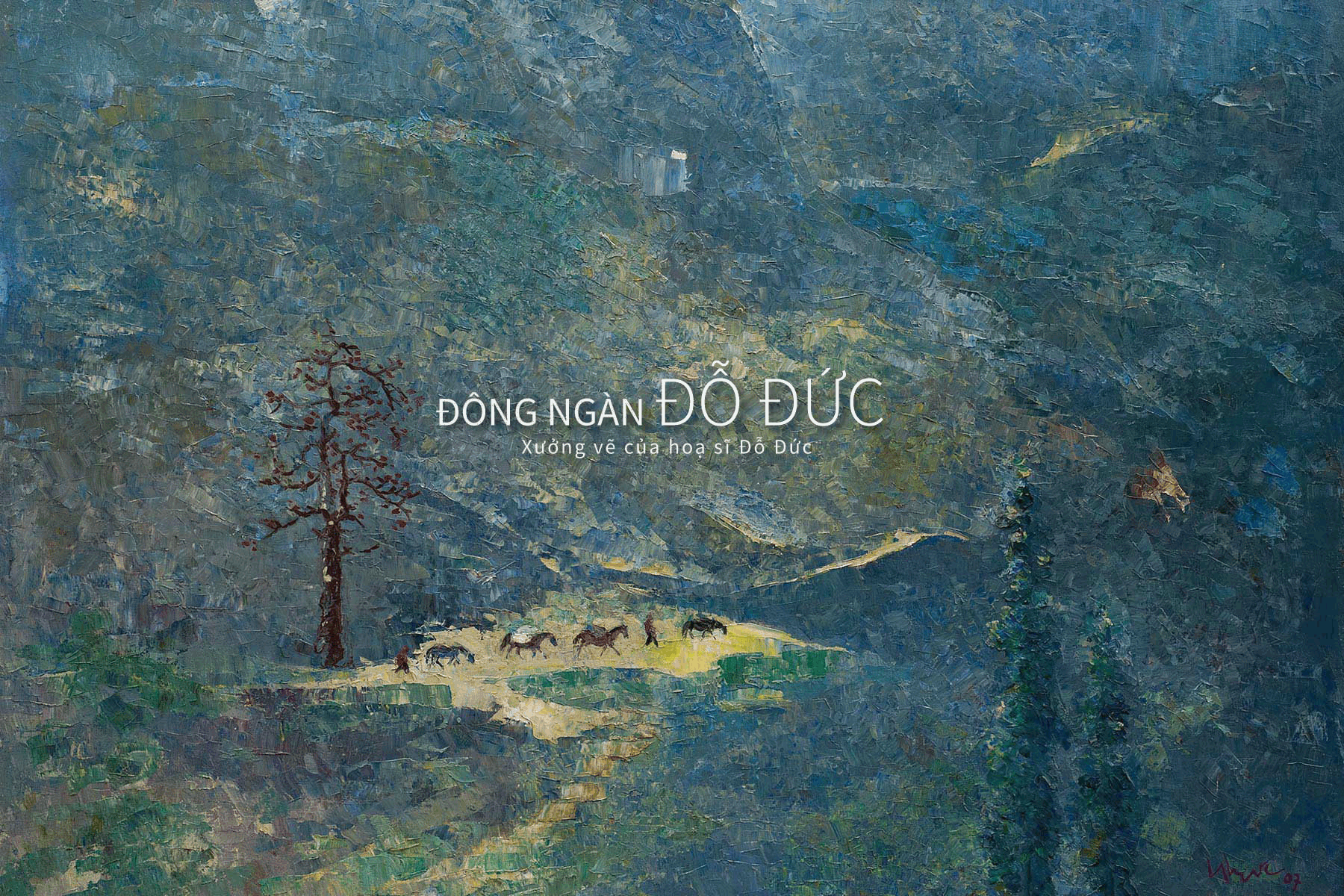
Painter · Printmaker · Writer
Đỗ Đức is a celebrated Vietnamese painter, woodcut artist, and writer whose life and work are deeply intertwined with the culture, people, and landscapes of Vietnam’s northern highlands. Often referred to as “The Artist of the Northern Mountains,” he is best known for his emotionally resonant depictions of ethnic communities, rugged terrains, and the quiet poetry of daily life.
Born in 1945 in Thái Nguyên—at the dawn of Vietnam’s independence—Đỗ Đức came of age during a period of upheaval and transformation. His early passion for drawing emerged in the face of personal difficulty. During the post-war Land Reform campaign, his family was classified as “medium-class” landowners, which meant that all members, including him, were barred from university education. Undeterred, he taught himself to draw, carving out his artistic path in solitude and determination.
He began his career as a reporter and newspaper illustrator, where his eye for storytelling quickly stood out. It wasn’t until the 1970s—after decades of policy revisions—that he was finally admitted to the Vietnam University of Fine Arts. By that time, he was already serving as the full-time Art Editor at the Ethnic Cultures Publishing House, and had, in spirit and practice, long been an artist.
The first 15 years of his artistic career were marked by his mastery of hand-carved woodcut prints. With expressive lines and a tactile sense of form, he brought to life scenes from remote villages and ethnic communities. His name became synonymous with the medium, and his works were acquired by institutions such as the Vietnam Fine Arts Museum and the Museum of Vietnamese Ethnology.
 |  |  |
In the next phase of his career, Đỗ Đức turned his attention to dó paper—a traditional Vietnamese handmade paper with roots in Hanoi’s Bưởi village. Typically reserved for calligraphy or Chinese ink painting, he reimagined it as a medium for watercolor. Under his hand, the paper took on new life, producing atmospheric, dreamlike paintings that softened edges and evoked emotion through delicate washes and subtle textures. This period became a defining chapter in his exploration of form, tone, and memory.
 |  |  |
Since the mid-2000s, he has devoted himself to oil painting, culminating in the exhibition Living on the Rock, which featured 50 works centered on life in Hà Giang’s stark, stony terrain. These oil paintings diverge from his airy watercolors with their dense, layered brushwork—offering an unflinching yet beautiful look at the endurance and spirit of highland life.

While best known for his visual art, Đỗ Đức is also a respected cultural writer and columnist, contributing essays and reflections to Thể Thao & Văn Hóa and other publications. His prose—often lyrical, observant, and tinged with humour—captures the nuances of Vietnamese life with the same clarity as his brushwork. As an active Facebook blogger, he continues to share thoughts on art, culture, and the changing face of Hanoi.
Since the passing of his wife in 2003, Đỗ Đức has remained widowed. He lives in a quiet house near Hồ Tây (West Lake), Hanoi, with his oldest daughter. He enjoys cooking, traveling, and continues to create and reflect with unyielding curiosity and compassion.
Born in 1945 in Thai Nguyen in 1945, when Vietnam declared independence, Do Duc began his career as a reporter and newspaper illustrator. He firstly studied painting by himself because his family was classified as “medium class” (the class that owned properties) in Land reform. As a result, all member in the family were barred from being approved to any university. It took decades for this to be corrected and Do Duc was finally admitted to the Fine Art University of Hanoi in the 1970s. He, however, had been a full time Art Editor at the Ethnic Cultures publishing house and is an artist for all his life.
Growing up in the mountainous area, Do Duc grows a deep love for the lives and people there. This became the focus of his career and is reflected in all of his work. After he relocated to Hanoi, he still frequently travels to different areas of North Vietnam and has a profound knowledge of the people and lives there.
The first 15 years of his career, Do Duc gained a reputation for his lively hand-carved woodblock printings. He has mastered the material to the level that when talking about woodcut, people mentioned Do Duc. It also was when he had his first paintings purchased by the Vietnam Art Museum.
Artistic Practice
Primary materials:
- Hand-carved woodcut
- Watercolor on dó paper
- Oil on canvas
Recurring themes:
- Ethnic cultures of Vietnam
- Mountain life and landscapes
- Everyday moments imbued with symbolism
- Human resilience, memory, and place
Memberships
- Vietnam Fine Arts Association
- Hanoi Fine Arts Association
- Vietnam Association of Folklore Arts
- Vietnam Association of Ethnology
- Vietnam Association of Ethnologic Arts and Literature
Selected Exhibitions
Solo Exhibitions:
- Hồ Chí Minh City: 1988
- Ninh Hiệp: 1990
- Vietnam Cultural Centre, France: 2009
- Hanoi: 1986, 1993, 2001, 2012, 2024
Group & National Exhibitions:
- National Fine Arts Exhibitions: 1976, 1980, 1985, 1990, 1995, 2000
- National Printmaking Exhibition (Award B): 1985
- Asian Printmaking Exhibition: 2012, Hanoi
International Exhibitions:
Mongolia (1981); Bulgaria (1981–87); Cuba (1981); USSR (1985–86); USA (1985–86, 2000); Germany (1983–90); Czechoslovakia (1986–89); Italy (1990); Norway (1992–97); China (1993); Bangladesh (1993); Japan (1998); South Korea (2008)
Collections & Recognition
- Award B, National Printmaking Exhibition, 1985
- 14 works in the collection of the Vietnam Fine Arts Museum
- 15 works in the Museum of Vietnamese Ethnology
- Works held in public and private collections in Poland, the United States, and across Asia